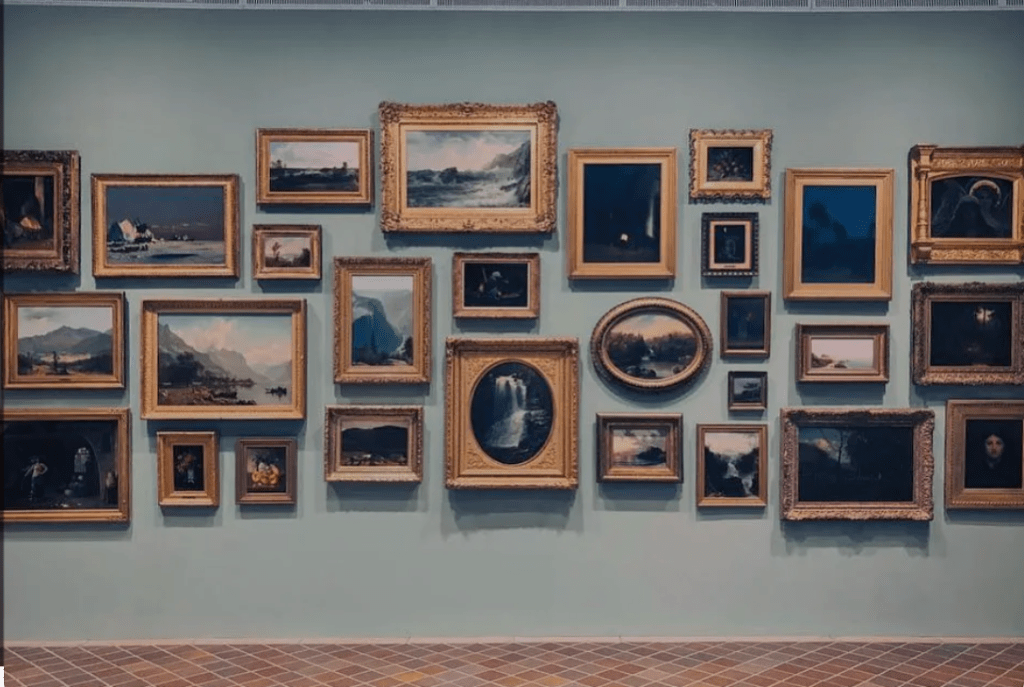
The role of collections in a museum.
If you were to stop an average person walking in front of a museum and asked them about the museum’s collection department, imagine how they might respond. They might describe a treasure trove of timeless and permanent objects, some on display and some sitting in shelving accumulating dust. But as we’ve learned this semester, that idea of permanence is nothing but a myth. A museum collections department is anything but a tomb of treasure but is a dynamic department that has many arms of operation. It requires dedication and passion to move forward in evolution with the ethically charged and ever-changing technologies of archiving, preservation, exhibition and ownership reflecting the also evolving ethics, values, cultural priorities, and historical accountability of the world outside the museum doors.
I might have been one of those average persons if one was to ask me that question a year ago. But since coming into the museum studies program, I have realized the definition of “collections” is not so static nor succinct. I have come to define the “collections” department as the custodians of the objects a museum either owns or borrows. They are responsible for their physical care, the documentation of both their state and history/provenance, their access and use, repairs, and at times their return to their rightful owners. There are many different branches to the collections department which includes collections managers, registrars, conservators, curators, provenance researchers, and repatriation specialists. These divisions are not seen by the public, but without each of them, the museum would not be able to function. The department as a whole serves as the backbone of the museum. As mentioned in the “DEAI Toolkit,” the professions that outfit the collections department are not only the caretakers of these objects, which can number from the thousands to the millions, but they also work as agents of cultural repair and ethical collecting.
The position I find most intriguing in the collections department is that of repatriations. In its simplest definition, repatriation is the returning of objects or remains to the communities of origin or rightful owner. These objects were often originally obtained in problematic circumstances, such as through coercion, violence, or theft, or even through unjust laws created specifically to take such items. Legally, the museums do not own them, and they must be returned to the rightful owner. But the situation is far more complex than just complying with legal judgments, but rather an ethical endeavor. When returning a stolen or looted item, a balance is restored, healing people and their relationships by recognizing sovereignty and rectifying wrongs. For example, the provenance curator at the Museum of Fine Arts in Boston, Victoria Reed has worked to research and restitute art stolen from Jewish families during the Holocaust. (Reed, 2015) The Metropolitan Museum of Art has hired Lucian Simmons for the newly created a position titled of Head of Provenance Research. He was formally the head of Sotheby’s restitution department, but is now spearheading the task at the Met, the center of much controversy in recent years for the looted art in its collection. With his efforts, he and his team have already returned antiquities to Cambodia and Greece and have blocked new acquisitions with provenance that was questionable. (Bowley & Mashberg, 2025) The addition of this position and those that are similar signals an institutional shift towards museums confronting the legacies their collections might have of colonialism and looted art. This recent commitment that museums have made to be proactive in the restitution of looted art is also part of a broader international movement to address the ongoing emergence of art looted during the era of the Nazis. Museums are directing internal investigations to return items under question, although bought or acquired under good faith, to their proper owners. Transparency has become essential to the reputations of museums once thought to be impenetrable.
It is estimated that more than 650,000 works of art were stolen during this period, around one-fifth of the art that existed in the world during WW2. (Shoumatoff, 2014) Major efforts were made after World War II to return as much as could be found, but the ghosts of the past are haunting the art markets today. The task of restitution has fallen to the heirs, often the grandchildren or great-grandchildren of the victims of the Nazis, and they must seek out justice for their forebears. As Michael Marrus wrote:
“Restitution is more about the present than the past: it speaks to the survivors who are still among us. . .to the society at large for which such issues may be said to matter. . . and to a world in which injustice and wrongdoing are still too common- but for which, at the very least, we should have mechanisms available, when the carnage ends, to seek some measure of justice.” (Evans, 2011)
The ramifications of this, the “greatest art theft in history,” are still reverberating. The necessity of understanding the nuances of restitution given the consistent emergence of art suspected of being stolen or coerced from victims of the Holocaust. (Evans, 2011) As more and more artworks are coming to the public’s eye, decisions are being made as to the ethically objective course of action. The provenance of works is being minutely inspected, and more cases than ever are being decided in courtrooms. The 2024 update to the Washington Principles, titled “Best Practices for the Washington Principles on Nazi-Confiscated Art,” further clarification is given for what constitutes a just and fair solution. It affirms that the interests of Holocaust victims and their heirs must be given priority and that sales under duress during 1933–1945 can be presumed involuntary unless proven otherwise. (Hickley, 2024) These refinements offer stronger moral guidance and shift the burden of proof away from families who have already lost so much. With the distance of time, artworks inherited from parents and grandparents, unaware of their origins, are bringing them to auction or exhibition and these are recognized by the heirs of those from whom they were stolen. Both the public and the institutions themselves are reckoning with the ever-present ghosts from the brutal past of these stolen art works.
Technology is essential to do this work effectively and efficiently. Members of the collections staff can use database programs such as PastPerfect Museum Software or TMS to streamline the daunting task of cataloguing objects. These performance software programs can be used to track the object, document provenance, and manage all other details. These tools can help identify problematic provenance. (Campbell & Baars, 2021) These sorts of programs are exceedingly helpful, but there is a cavate. The technology is not neutral as the information entered is done so by a person. How data is entered, classified, and made accessible can either uphold or challenge existing hierarchies of knowledge and access. (Csikszentmihalyi & Hermanson, 1995)
The intersection of museum collections and SEAI – diversity, equity, accessibility, and inclusion- is compelling. Historically, museum collection contains the perspective of a single point, that of wealthy, white elites, preserving the history of colonialism and exclusion. The gaps created by the exclusion of women and minorities is still prevalent in many museum galleries. As described in The Lost Museum, the Jenks Museum’s collection of natural history specimens became obsolete when the institution’s academic focus changed, ultimately leading to its improper deaccessioning, including 92 truckloads dumped at a landfill. This story is an important reminder that even “permanent” collections are subject to institutional neglect and shifting values. (Daly, 2017, p.1)
The DEAI Toolkit asks us to consider: Who is reflected in the collections? Who is missing? And who decides? Repatriation work provides a direct way to act on these questions. It can also be paired with public programming to promote both transparency and learning. The article describes museums incorporating repartition stories into public programming. (Bazan, 2021) It is more than a publicity stunt, it is not only educating visitors but showing that the institution is able to be self-critical change. This is essential if museums are to survive in the changing society that embraces diversity and transparency.
As I pointed out before, my personal perspective of museum collections has changed dramatically since beginning this program. Far from being solely tasked with the physical care of an object, the work in the collections department is deeply, not only political, but philosophical. There is a balance of institutional critique, the collective voices of the community, and preservation required. As I look to the future towards the work I hope to do in a museum, I am deeply invested in the work of ethical practice and transformation in collections, not just preservation and display. I greatly admire the quiet and thoughtful work of museum professionals such as Victoria Reed, Lucien Simmons, or Kimberly Maston at LACMA. They work to trace the histories of objects, build relationships with communities, and transform the act of restitution into a moment of public accountability and learning. In these cases, collections care becomes a form of justice, rooted in respect for living cultures. I want to embrace the concept of ephemerality as one that is liberating; not everything can or should be kept forever. The Lost Museum symposium argued that impermanence is not failure. It is an opportunity to design museums that are responsive, reflective, and rooted in relationships rather than ownership. (Daly, 2017)
The collections department is not just a place where objects are stored and get dusty. It is the core of the museum, dealing with ethics and quandaries that require not only technical skill and knowledge but curiosity, cultural sensitivity, emotional intelligence, and a willingness to embrace change as a good thing. The museum professionals that staff the collections department are fulfilling some of the most meaningful work in the arts.
References
Bowley, G., & Mashberg, T. (2025, March 18). Art seizures at the Met caused concern. His job is to address it. The New York Times. https://www.nytimes.com/2025/03/18/arts/design/met-museum-provenance-research-lucian-simmons.html?searchResultPosition=14
Bazan, E., Black, S. W., Thurn, N., & Usbeck, F. (2021). Repatriation, Public Programming, and the DEAI Toolkit. Journal of Museum Education, 46(1), 27–37. https://doi-org.proxy1.library.jhu.edu/10.1080/10598650.2020.1847501
Campbell, B., & Baars, C. (2021). The curation and care of museum collections (2nd ed.). Rowman & Littlefield.
Csikszentmihalyi, M., & Hermanson, K. (1995). Intrinsic motivation in museums: Why does one want to learn? Curator: The Museum Journal, 38(3), 197–200. https://doi.org/10.1111/j.2151-6952.1995.tb01052.x
Daly, M., Kapsalis, E., & Pietruszewski, S. (2017). The lost museum: Ephemerality and afterlives of collections. Museum History Journal, 10(2), 109–132. https://doi.org/10.1080/19369816.2017.1320551
Evans, Richard J. (2011) “Art in the Time of War.” The National Interest, no. 113 (2011): 25, http://www.jstor.org/stable/42896376.
Hickley, C. (2024, March 5). Nations agree to refine pact that guides the return of Nazi-looted art. The New York Times. https://www.nytimes.com/2024/03/05/arts/design/washington-principles-nazi-looted-art.html
Reed, V. (2015). Nazi-era provenance research at the Museum of Fine Arts, Boston. Journal for Art Market Studies, 1(1). https://www.fokum-jams.org/index.php/jams/article/view/1
Shoumatoff, Alex. (2014) “The Devil and the Art Dealer,” Vanity Fair, March 19, 2014, https://www.vanityfair.com/news/2014/04/degenerate-art-cornelius-gurlitt-munich-apartment
 Kathryn E. Jacob
Leave a comment